
Why I Switched to Canon: R5 Mark II, C50 and My Full Kit
Why I Switched from Sony to Canon
I've switched from Sony to Canon. If you follow me on Instagram or caught my last few YouTube videos you will have seen it coming, and honestly it has been sitting in the back of my mind for a long time. After months of thinking about it, and a few weeks testing everything on real client shoots, I'm all in.
It started last December in Sweden with my mate Jack. Every evening we would sit down and go through the day's shots, and I kept looking at my files, then looking back at the files from his Canon. The colour, the detail and the way it handled the light just kept pulling me back. That camera was the Canon EOS R5 Mark II, and I have wanted one ever since.
The real turning point though was the Canon EOS C50. Most of my work is video, from automotive and brand content to documentary work, so I needed a cinema camera that could do absolutely everything. The C50 matched everything my Sony FX3 could do and then went further. That was the moment I knew I was switching.
In this post I'm walking through my entire new kit: the two camera bodies, the four lenses I've started with, the specs that actually matter, and why I chose each one for landscape, wildlife and filmmaking work.
Watch the full video here: Why I Switched to Canon | R5 Mark II, C50 and My Full Kit
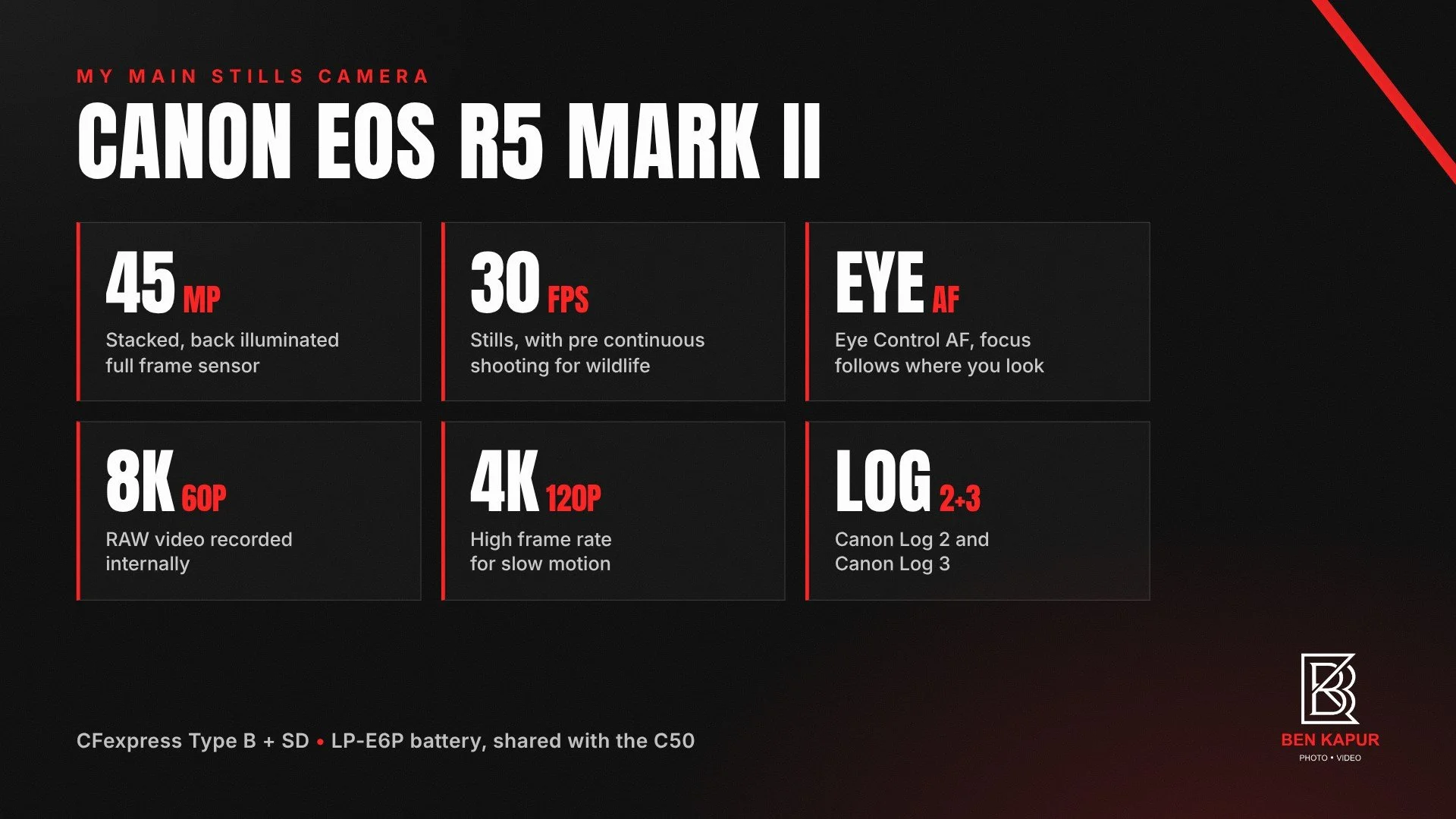
At its heart is a 45 megapixel full frame sensor that is stacked and back illuminated. In plain English, it reads the sensor really, really fast, so you get loads of detail without the usual compromises. Rolling shutter is far better than the original R5, so fast pans and moving subjects don't go wobbly.
Built for wildlife
Up to 30 frames per second for stills
Pre continuous shooting, which buffers up to half a second before you fully press the shutter
Dual Pixel Intelligent AF that tracks people, animals and vehicles, and stays locked on even when a subject turns away
Eye Control AF, where a sensor in the viewfinder follows where you are looking and moves the focus point there
Pre continuous shooting is a game changer for my wildlife work. A kingfisher leaving its perch happens in a fraction of a second, and now I'm not missing that moment because my reactions were a touch too slow. Eye Control sounds like a gimmick until you use it. Then it honestly feels like cheating.
Serious video too
8K RAW recorded internally at up to 60p
4K at up to 120p for slow motion
Canon Log 2 and Canon Log 3
Dual card slots, CFexpress Type B and SD, so I can back up as I shoot
Runs on the LP-E6P battery, the same one the C50 uses
I shoot Canon Log 2 all the time, so footage from the R5 Mark II cuts straight in with the C50 in the edit. And one set of batteries for both cameras makes life so much simpler on a shoot.
When I'm out on the coast with the R5 Mark II, my NiSi filters are always in the bag. If you want to build your own filter kit, my code Kapur-discount saves you money at nisioptics.co.uk.
Canon EOS C50: My Main Video Camera
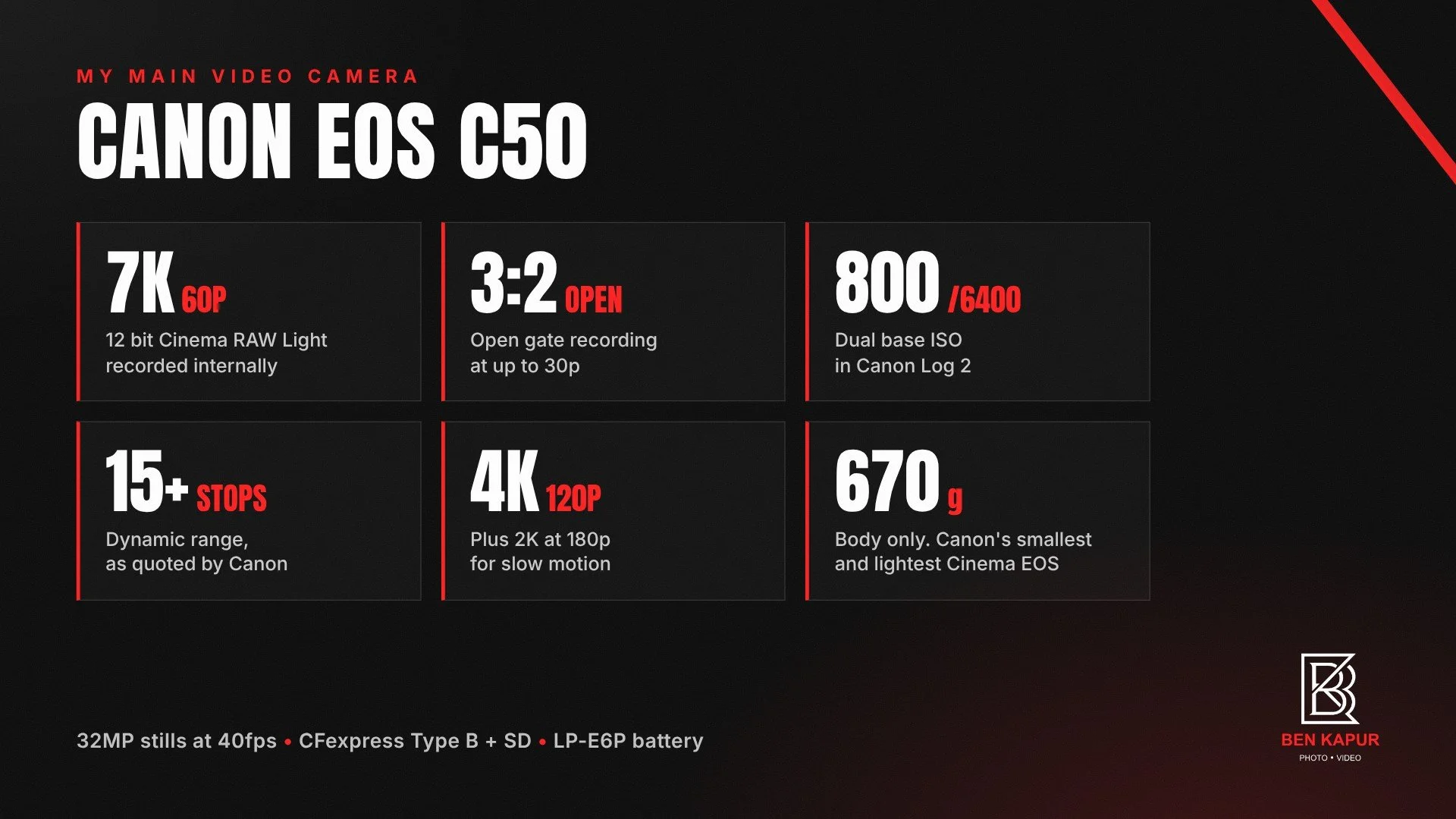
The C50 is Canon's smallest and lightest Cinema EOS camera, at around 670g for the body. On a gimbal or in a backpack it just disappears, which means it comes everywhere with me. I'd used a full frame cinema camera for years and loved it, but the C50 does everything I need and then some.
The specs that matter to me
7K full frame sensor
12 bit Cinema RAW Light recorded internally at up to 7K 60p, so no external recorder and no extra cables
3:2 open gate recording at up to 30p
4K at up to 120p and 2K at up to 180p for slow motion
Dual base ISO of 800 and 6400 in Canon Log 2
More than 15 stops of dynamic range, as quoted by Canon
CFexpress Type B and SD slots that can record at the same time
32 megapixel stills at up to 40 frames per second
Open gate changed how I shoot
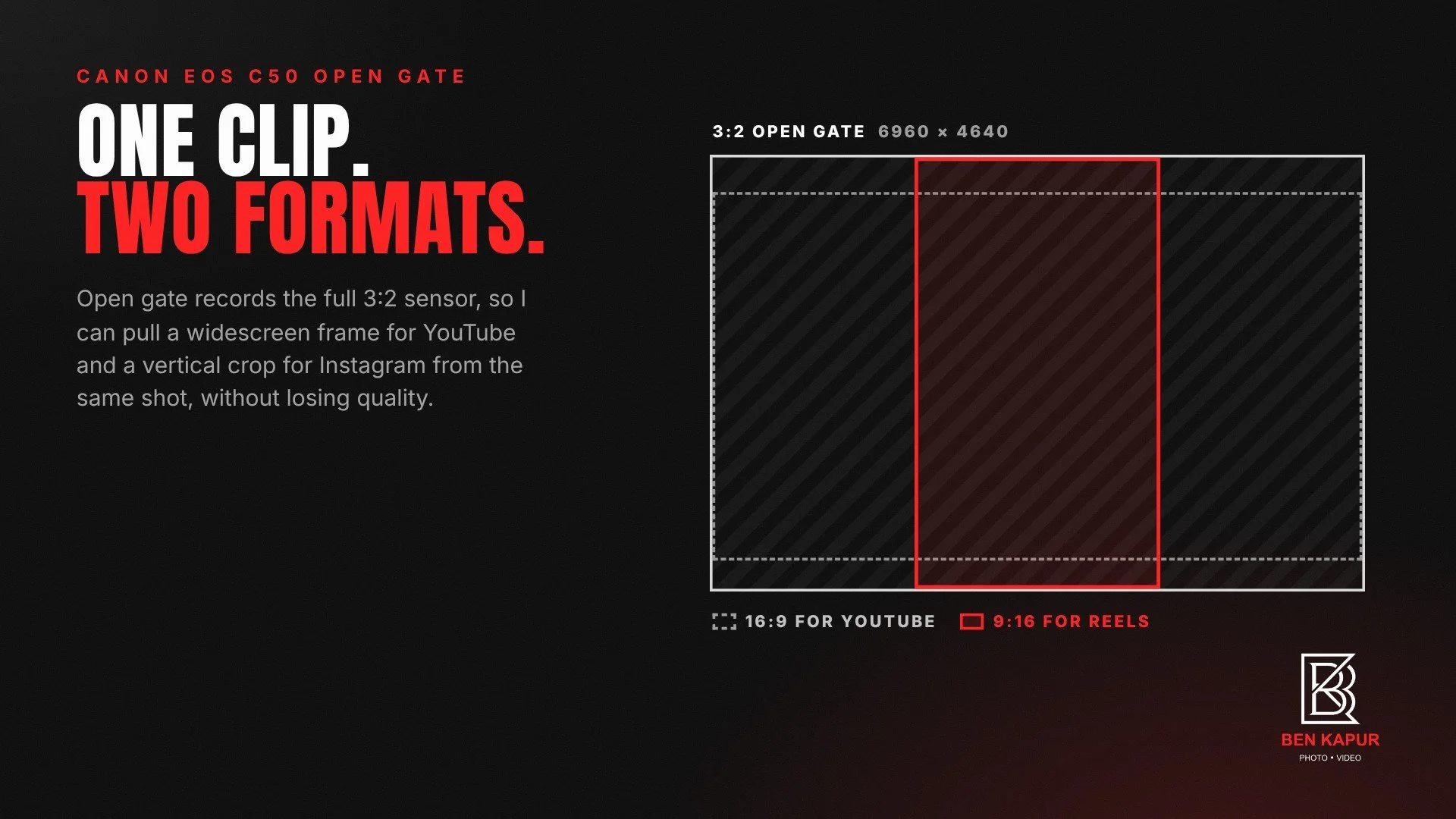
Open gate is the feature I use the most. It records the full 3:2 sensor, so from one clip I can pull a widescreen frame for YouTube and a vertical crop for Instagram without losing quality. For the way I work, where most jobs need horizontal and vertical deliverables, that is huge. It pretty much shoots everything I need in one go.
Clean footage when the light drops
The dual base ISO is the other big one. When the light goes in blue hour on the coast, or I'm sitting in a hide, I switch to ISO 6400 and the footage stays clean. Combined with all that dynamic range, it gives me so much to work with in the grade.
What about stabilisation?
There is no in body stabilisation on the C50, and I genuinely haven't missed it. Most of the time it's on a gimbal, and the RF lenses I've chosen all have optical stabilisation built in, so handheld work stays smooth.
It also doubles as a 32 megapixel stills camera when I need it to. For the money, the C50 is punching way above its weight, and it is now an absolute staple in my bag.
My Canon Lenses for Landscape, Wildlife and Filmmaking
I've started with four lenses. Three are the classic f/2.8 zooms and the fourth is a big wildlife prime, and between them they cover everything from sweeping Jurassic Coast views to kingfishers at 700mm.
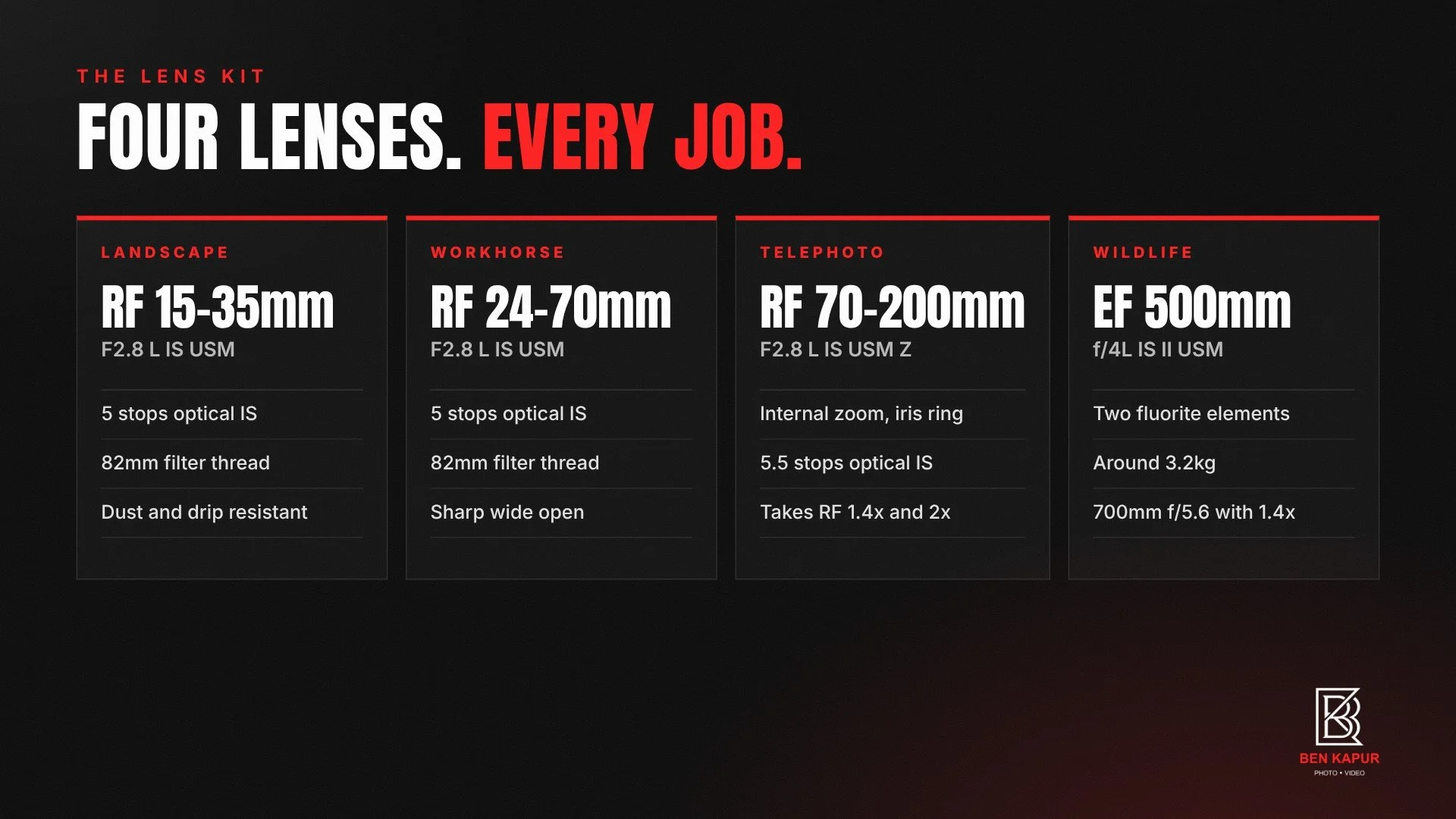
Canon RF 15-35mm F2.8 L IS USM: The Landscape Lens
This is the lens I reach for on the Jurassic Coast, up on the hills at sunrise, or anywhere with a big view. 15mm gives me so much room for sweeping scenes, and being able to punch in to 35mm is still really useful for tighter compositions without swapping lenses.
f/2.8 for blue hour, astro and filming in dark interiors
5 stops of optical stabilisation, which is exactly why I don't worry about the C50 having no in body stabilisation
Quiet, fast Nano USM autofocus
Dust and drip resistant, which matters when you spend half your life on a windy, salty coastline
82mm filter thread
Canon RF 24-70mm F2.8 L IS USM: The Workhorse
If I could only take one lens out, this would be it. It covers wide, standard and a bit of telephoto, so I can go from an establishing shot to tight details in seconds. When you're working fast or the weather is turning, not having to swap glass makes a massive difference.
It is incredibly sharp right across the range, even wide open at f/2.8, so I get lovely background separation and can keep shooting as the light drops. It also has 5 stops of stabilisation and quick, quiet autofocus. It's my go to lens for client work, behind the scenes, travel and pretty much everything in between, and on the C50 it makes a compact, really capable filmmaking setup.
Canon RF 70-200mm F2.8 L IS USM Z: The Sharpest Lens I've Ever Used
The Z version is the one I really wanted. Unlike the older RF 70-200mm, it zooms internally, so the lens never gets longer and the balance never changes. That is perfect on a gimbal or tripod, because I can zoom mid shot without rebalancing anything. It's clearly been designed with filmmakers in mind.
A proper iris ring for smooth aperture changes while recording
Optional Canon power zoom adapter for smooth, broadcast style zooms
Works with the RF 1.4x and RF 2x extenders, which the older version can't use
5.5 stops of optical stabilisation and dual Nano USM focus motors
Around 1.1kg, which is very reasonable for what it is
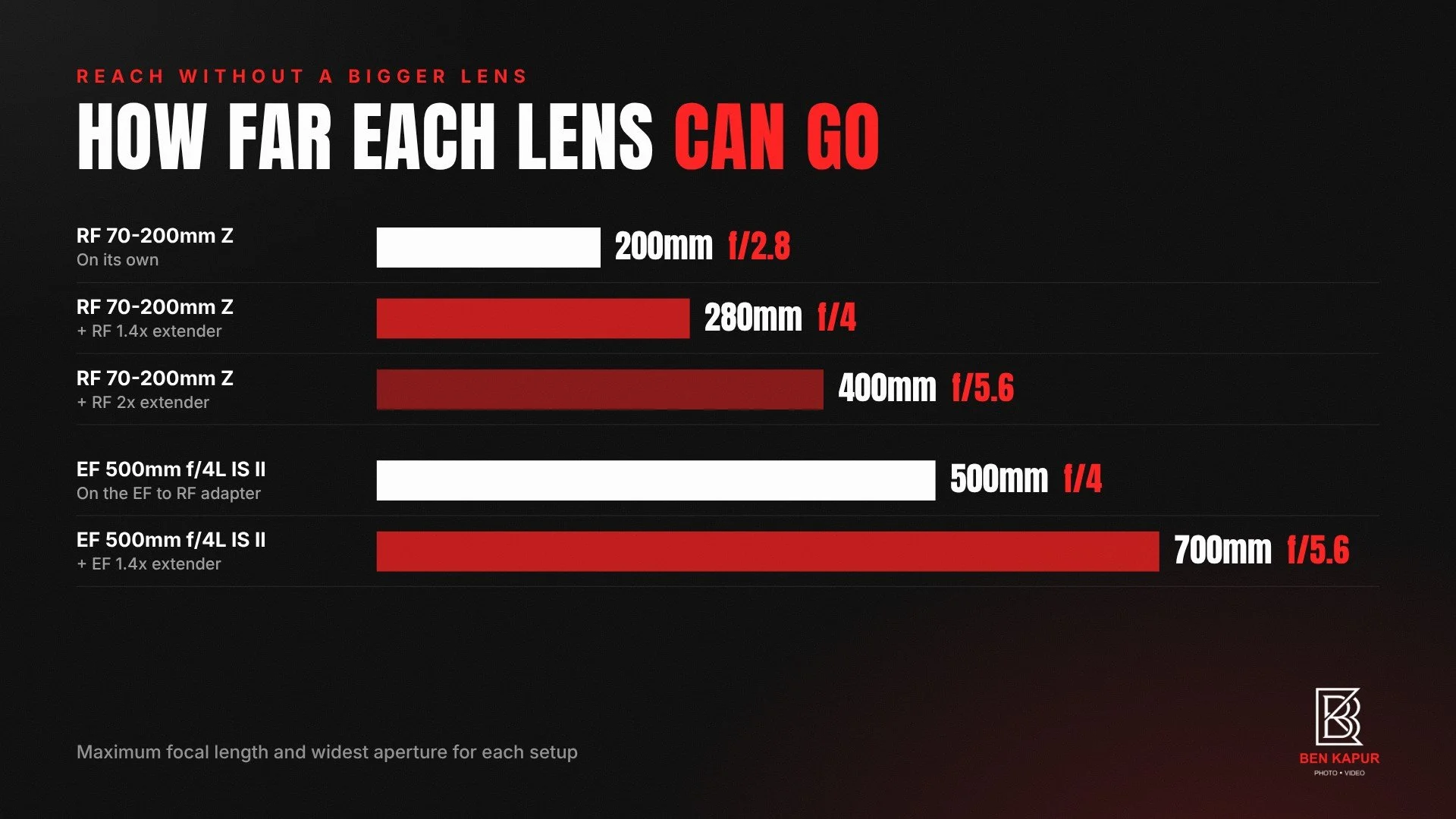
With the extenders it becomes a 280mm f/4 or a 400mm f/5.6 without packing a big lens. I've used it for compressed landscapes with hills rolling into the fog, portraits, events and wildlife, and it makes everything look expensive. Out of every lens I've used over the years, this is the sharpest. I'm genuinely not exaggerating.
One small thing I love: the 15-35mm, 24-70mm and 70-200mm Z all take 82mm filters. That means one set of NiSi filters covers all three, which is less to carry and less to buy. If you're kitting out a new system too, use Kapur-discount at nisioptics.co.uk.
Canon EF 500mm f/4L IS II USM: The Big Wildlife Lens
You might be wondering why I went for an EF lens on a mirrorless system. Honestly, this is one of the best wildlife lenses Canon has ever made. It has two fluorite elements, it's incredibly sharp, and on Canon's EF to RF mount adapter it works brilliantly on the R5 Mark II, with full autofocus and full subject tracking.
The Mark II is also much lighter than the original version, at around 3.2kg, so handholding it is very doable.
The real reason though is value. New RF super telephoto primes like the RF 400mm f/2.8 and RF 600mm f/4 are incredible, but they cost well into five figures. On the used market, the EF 500mm f/4L IS II gets you f/4 pro level glass for a fraction of that price. At f/4 I can photograph kingfishers earlier in the morning when the light is low, and with a 1.4x extender it becomes a 700mm f/5.6.
For my wildlife work and my kingfisher workshops it was a no brainer. If you want a big prime without the RF price tag, look at the EF 400mm f/2.8, EF 500mm f/4 and EF 600mm f/4. This lens is absolutely slept on.
Why This Canon Kit Works So Well Together
The biggest win of switching is how well everything fits together as one system. On a working shoot, the less I have to think about kit, the more I can think about the shot.
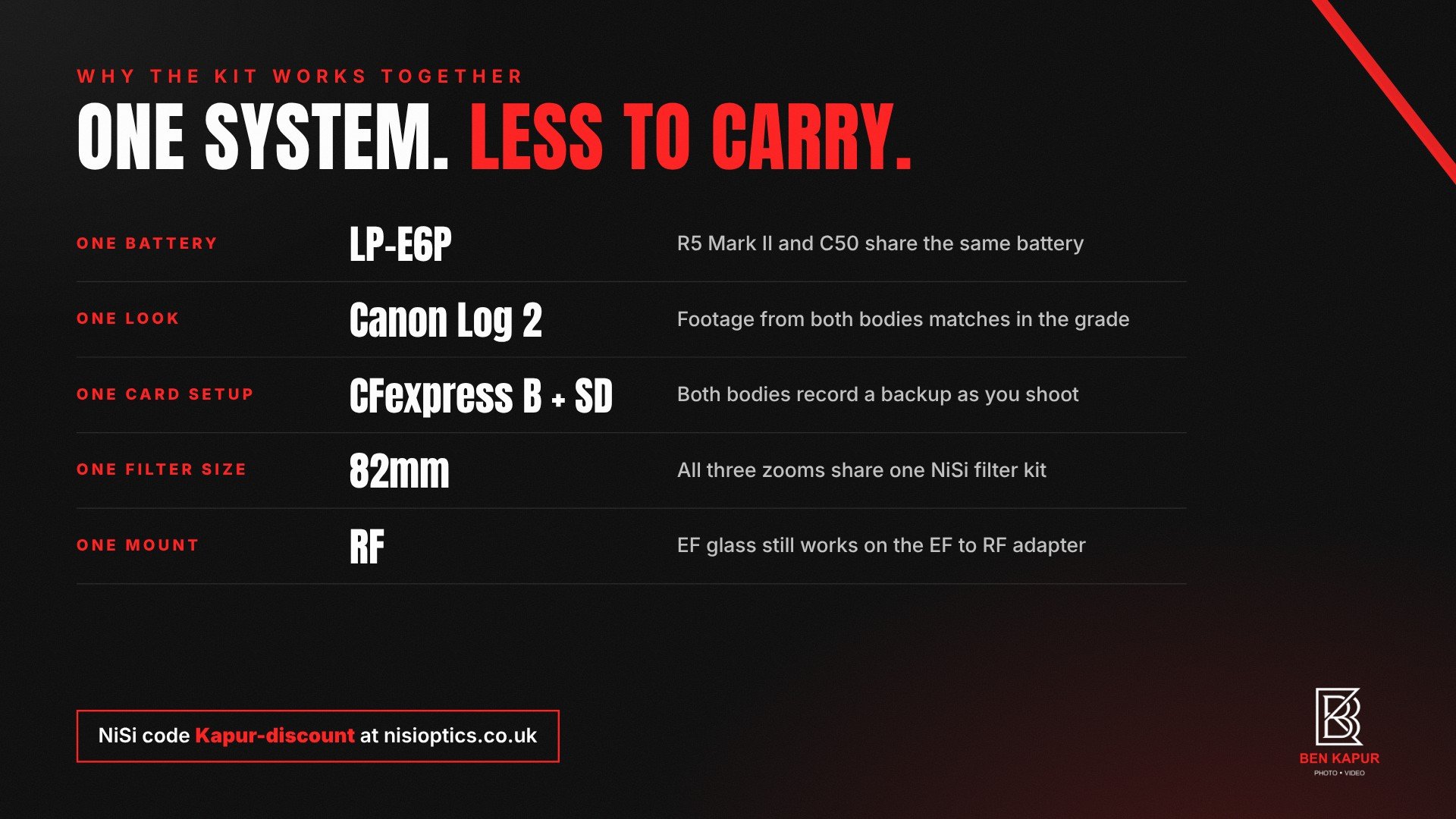
One battery: the R5 Mark II and C50 both run on the LP-E6P
One look: both shoot Canon Log 2, so the footage matches in the edit
One card setup: both have CFexpress Type B and SD slots for instant backups
One filter size: all three zooms take 82mm filters
One mount: RF lenses go on both bodies, and my EF 500mm works on the adapter
Final Thoughts on Switching to Canon
It's been really exciting switching over and getting to grips with how these cameras work. I've known about the R5 Mark II for a long time, and I'm absolutely blown away to finally have it in my bag. The C50 has become my main video camera, and the 70-200mm Z is genuinely the sharpest lens I have ever used.
Next up, I'll be picking up the RF 1.4x and RF 2x extenders for the 70-200mm Z, which will be brilliant for wildlife. I might also add an R6 Mark III as a second stills body over the next year or so.
What do you shoot on? Are you a Canon shooter, and is there a lens or body you think I should look at? Let me know over on the YouTube video or on Instagram @benkapurphoto.
Try Canon Kit With Me at Portland Bill
On Tuesday 1 December I'm running a landscape and seascape photography workshop at Portland Bill with Wex Photo Video and Canon. We'll spend the afternoon on the Dorset coast working on lighthouse compositions, long exposures and movement in the waves, building up to sunset.
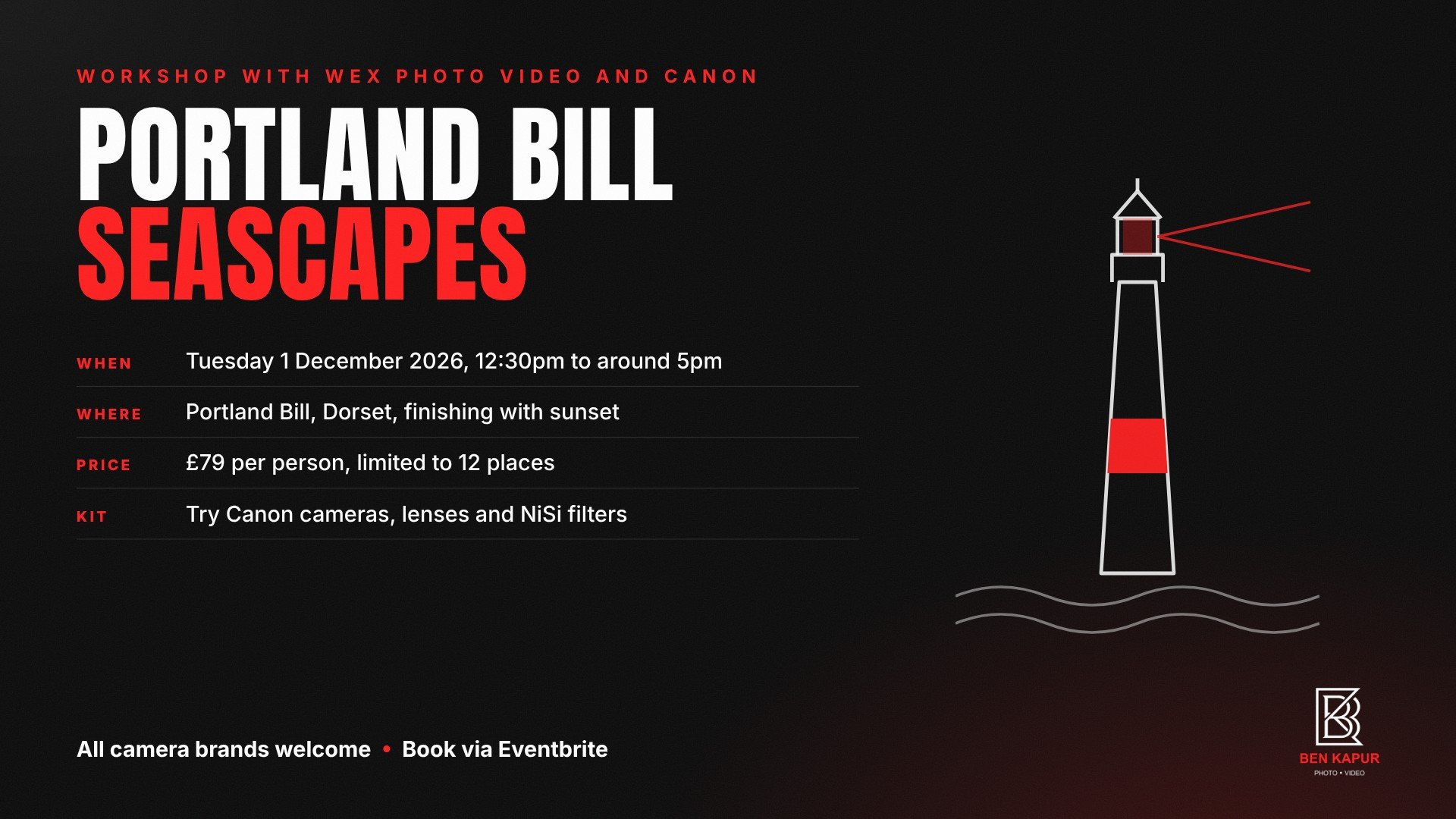
When: Tuesday 1 December, 12:30pm until around 5pm
Where: Portland Bill Car Park, Portland, Dorset, DT5 2JT
Price: £79 per person, limited to 12 places
Kit: the Canon team will have cameras and lenses for you to try
Filters: I'll be showing how I use NiSi filters, with a selection to try and buy
You don't need to shoot Canon. All camera brands are welcome, so come along, shoot some seascapes, try the kit if you want to, and hang out with me and the Wex and Canon teams. Spaces are limited, so be quick.
Book your place at the Portland Bill workshop
Useful Links
Watch the full video: Why I Switched to Canon on YouTube
My FREE DaVinci Resolve Powergrade: benkapur.com/my-free-powergrade
NiSi Discount Code: Kapur-discount, usable at nisioptics.co.uk
Follow along: www.benkapur.com | Instagram and Facebook @benkapurphoto
